 Coredem
-
Non-State Actors and Public Health Policies
The role of civil society in the co-production of health services and in defining public health policiesDownload
-
-
Course of Debates and proposals on power legitimacy in the Andean region
-
Two films report on the international symposium “Process of Debates and proposals on power legitimacy in the Andean region” (Lima 15-17 February 2009). Its proceedings are under publication.
Movies
-

Synthèse (version longue)
-

Synthèse (Version courte)
Download
-
-
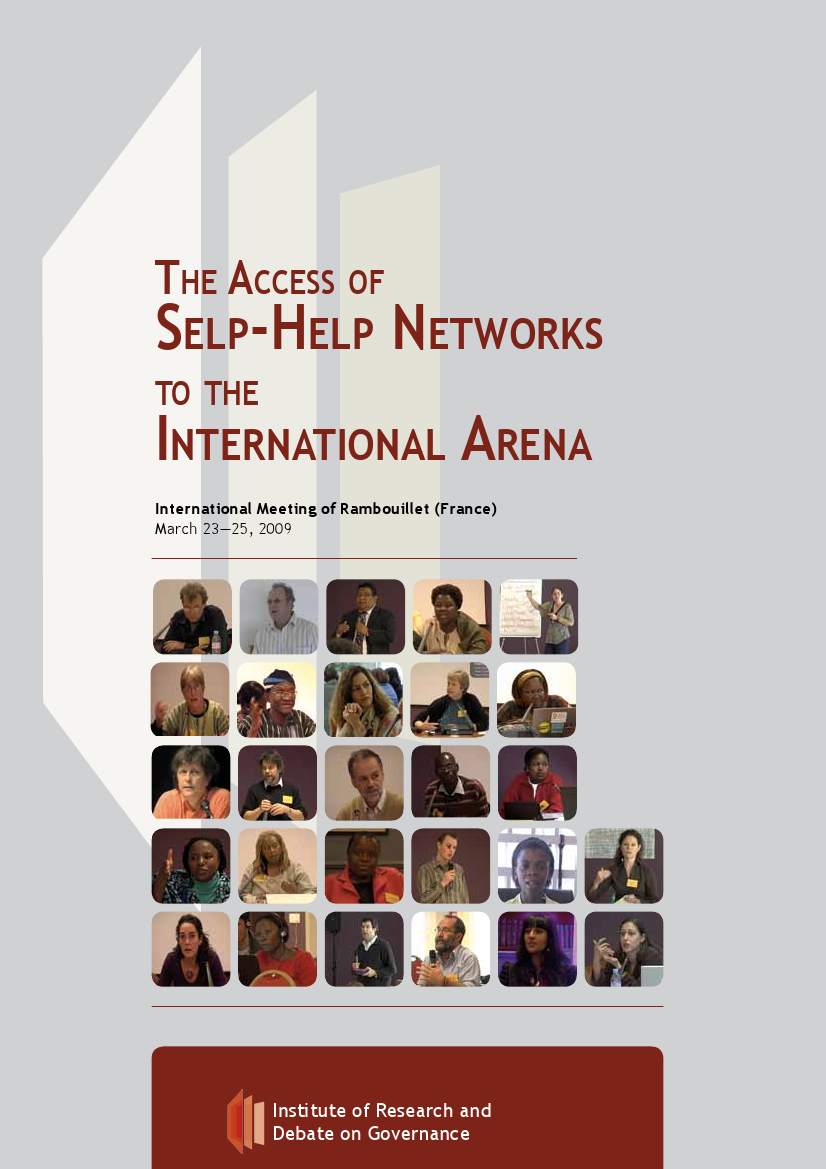
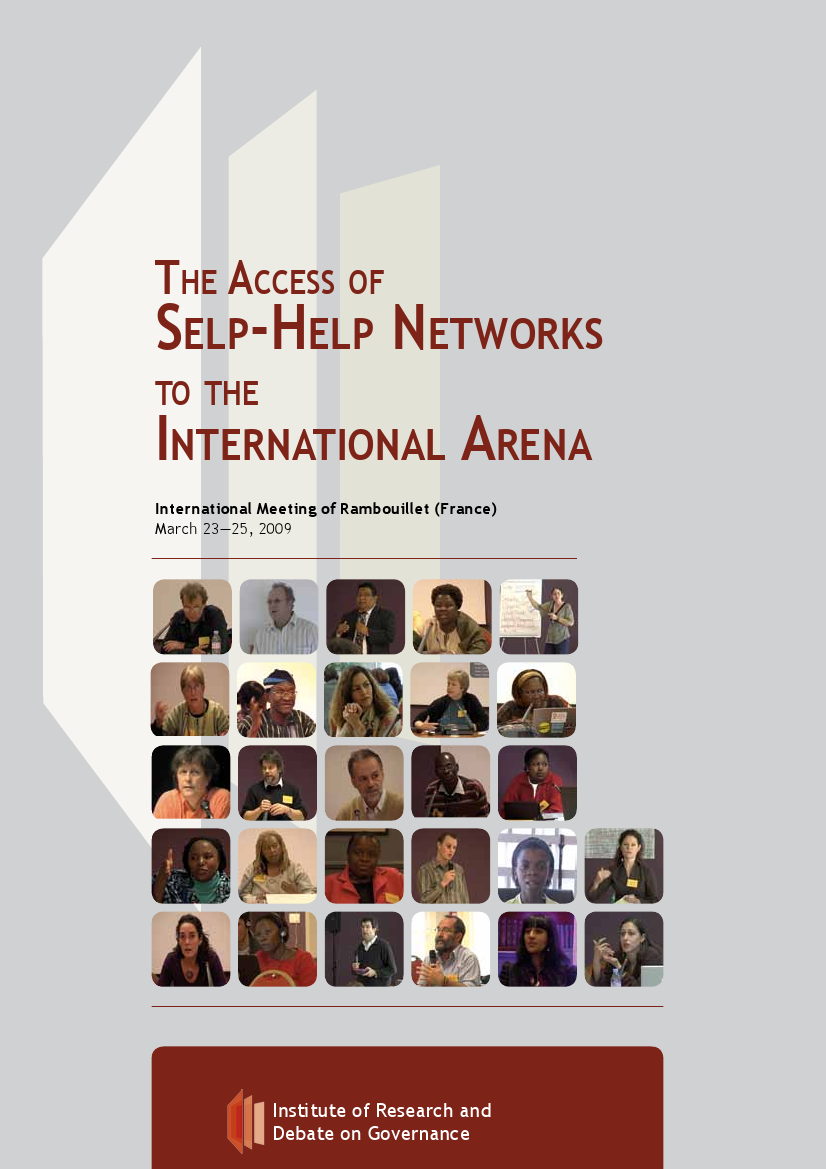
The Access of Selp-Help Networks to the International Arena
International Meeting of Rambouillet (France) - March 23—25, 2009-
In March 2009, the Ford Foundation and the Institute for Research and Debate
on Governance (IRG) invited members from eleven different self-help networks
and community-based/grassroots organizations to participate in a joint seminar.
Its aim was to come to a better understanding of how groups of this kind structure
themselves and how they engage in global advocacy. The seminar was also meant
to strengthen the groups themselves, through the sharing of experienced practices, successes and failures.
Movies
-

Rambouillet Meeting
Download
-
-
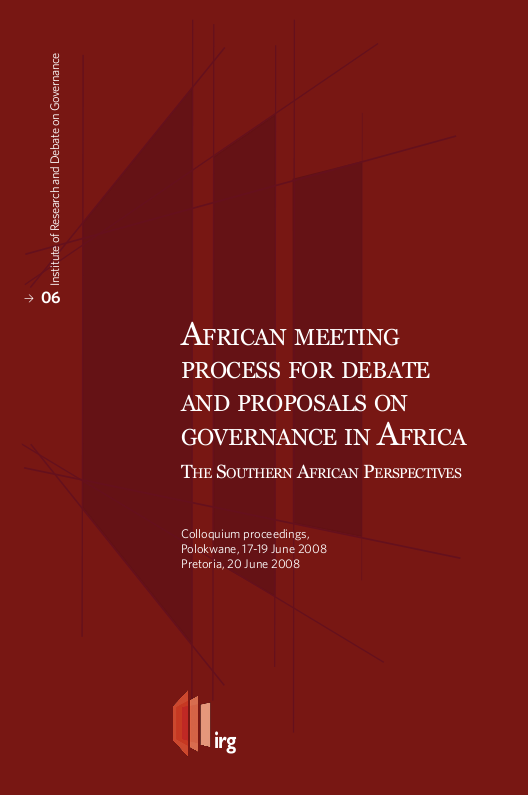
Debate and Proposals on Governance in Africa : The Southern African Perspectives
-
Beyond the couple "tradition-modernity", which sources of power legitimacy are at work in a country? How are they linked? What are the questions and proposals that can be drawn in order to better understand real governance in the related societies and to promote the elaboration of more legitimate and thus more effetive public policies? Lying at the heart of governance in Africa, these questions are the core issues of the Meeting Process for Debate and Proposals on Governance in Africa, coordinated by the IRG.
These proceedings and the DVD present the key contributions and debates that took place in Polokwane.
Movies
-

Short Movie
-

Full version Movie
Download
-
-
Governance of NGOs and their Part in the Co-production of Public Services
Summary of the 2nd Forum on the governance of NGOs and their part in the co-production of public services, Beijing, 9-11 November 2007-
The eye of the world is on China, immense “workshop of the globe”,
the breathtaking growth of which stirs up admiration and anxiety in
equal parts, in the West and beyond. But does the world really
understand China and the deep shifts at work in its society? In 2006,
the 6th plenary session of the 16th congress of the Communist Party
called for the construction of a “more harmonious socialist society”;
and yet, seen at close quarters, Chinese society seems riven with
grave social conflicts, which frequently escalate into violence. What
can be the part of “NGOs” in the quest for a new societal model and
how much room for manoeuvre do they enjoy?And the reverse is also true. For the way France – and more
broadly Western Europe – is perceived on other continents is frequently
rather crude. Dazzled by the glow of economic wealth, outside
observers may not always pick up on the phenomena of financial
insecurity and deprivation experienced here. And the reputation
of our so-called European style welfare state all too easily detracts
from the part played by associations and NGOs in the production of
social services in Europe.From the erstwhile Empire of the Middle to France, the role of nonstate
actors in the organisation of society and in the production of general
interest services counts indeed among the most relevant governance
issues today. France has a long tradition of involving the third, non-trading
sector in the provision of public services. China is an absolute beginner
in this field. The confrontation, during the Beijing Forum, of practices
on either side turned out to be a common necessity: for the fast-changing
Chinese civil society and public authorities, the experience of
French NGOs and associations is obviously a mine of useful lessons. But
for the latter, there is no less to be gained from subjecting their often
archaic practices to the scrutiny of Chinese partners seeking solutions
applicable today to a society in the of throes a deep and swift evolution.
Download
-
-
Civil Society Intervention in the Reform of Global Public Policy
-
Civil society actors throughout the world are increasingly involved in public policy making, on the national as well as the international level. Their strategies and impact was the theme of an international seminar held in Paris in 2007, jointly organized by the Institute for Research and Debate on Governance and the Ford Foundation. Thirty scholars and civil society leaders exchanged ideas on how they influence public policy and make their voices heard within the global public sphere. These proceedings present the main themes of their discussions.
Download
-
-
Entre tradition et modernité, quelle gouvernance pour l’Afrique ?
Actes du colloque de Bamako 23, 24 et 25 janvier 2007-
En quoi les valeurs traditionnelles de l’Afrique, son histoire, ses expériences politiques passées, peuvent-elles servir de base à une réflexion sur une nouvelle manière de concevoir la gouvernance dans cette région ? Comment tradition et modernité, légalité et légitimité, peuvent-elles s’articuler et se renforcer mutuellement aujourd’hui ? Pour en débattre, une trentaine d’universitaires, de personnalités politiques et religieuses, de chefs traditionnels se sont réunis à Bamako en janvier 2007 au cours d’un colloque peu conventionnel, de par la diversité de l’origine de ses participants. Les actes de ce colloque, présentés ici, sont accompagnés d’un DVD qui donne à voir les moments forts des débats.
Download
-
A NEW STAGE FOR THE IRG
The compass of the IRG has changed. Have a look at its new project on www.institut-gouvernance.org.
Viewpoints
>> See all videos